

Fair Housing Resources
Access information, guides, and tools to help you understand your fair housing rights — whether you are a renter, homebuyer, landlord, or housing professional.
Fair Housing Protections in San Diego County
- Race, color, national origin, and religion
- Sex, gender identity, and gender expression
- Disability and familial status
Fair Housing Protected Classes
Race & Color
It is illegal to discriminate in housing based on race or skin color under federal fair housing law.
National Origin
Where you or your family are from cannot be used as a basis to deny you housing or housing services.
Religion
Your religious beliefs or practices may not be used to discriminate against you in housing.
Sex & Gender
California law protects against sex, gender identity, and gender expression discrimination in housing.
Familial Status
Having children under 18, or being pregnant, cannot be used to deny you housing.
Disability
Landlords must provide reasonable accommodations and modifications for people with disabilities.
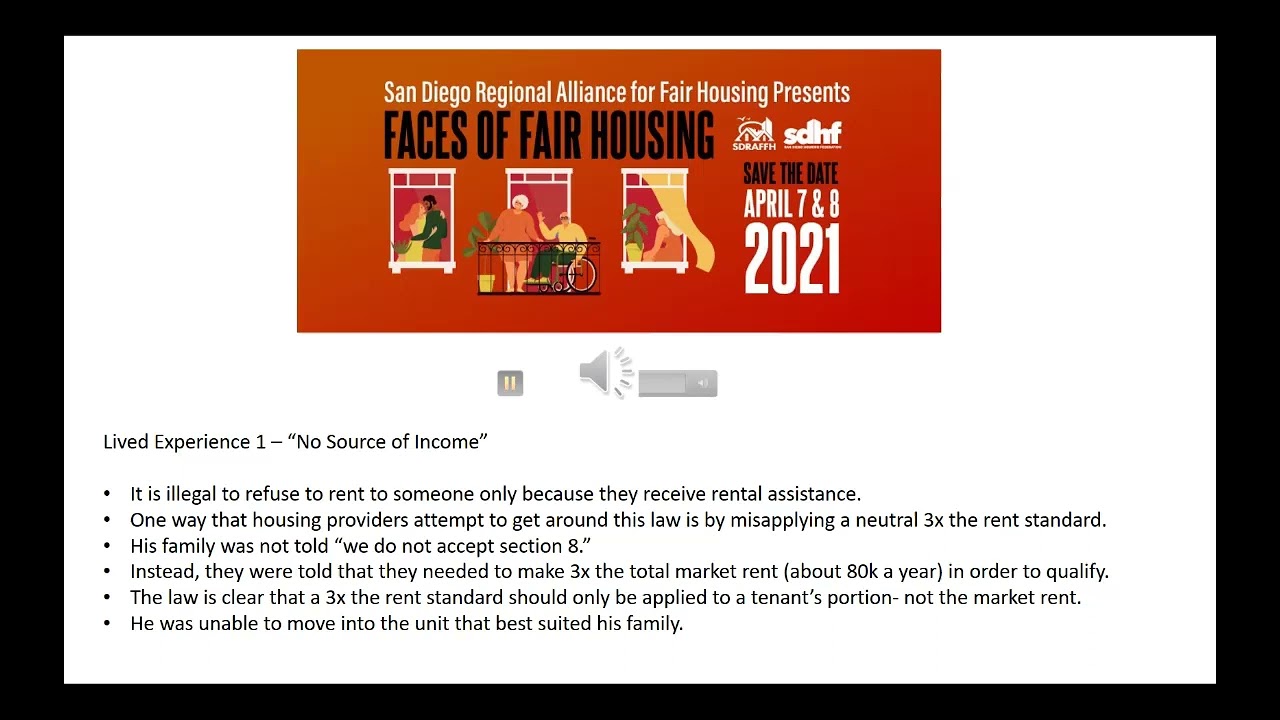
Source of Income
California law prohibits discrimination based on your source of income, including housing vouchers.
Marital Status & More
California additionally protects ancestry, marital status, sexual orientation, and medical condition.
Sexual Orientation
California law protects you from housing discrimination based on who you love.
Age
You cannot be denied housing or treated unfairly simply because of how old you are.
Citizenship / Immigration Status
Your citizenship or immigration status cannot be used to deny you housing or housing-related services in California.
Primary Language
The language you speak at home cannot be used as a basis to discriminate against you in housing.
Military / Veteran Status
California law protects active military members and veterans from discrimination in housing based on their service.
Arbitrary Discrimination
No landlord or housing provider may discriminate against you for any arbitrary personal characteristic not related to your ability to be a tenant.
Arbitrary Discrimination
No landlord or housing provider may discriminate against you for any arbitrary personal characteristic not related to your ability to be a tenant.
Arbitrary Discrimination
No landlord or housing provider may discriminate against you for any arbitrary personal characteristic not related to your ability to be a tenant.
Key Fair Housing Laws
The Fair Housing Act
The federal Fair Housing Act (Title VIII of the Civil Rights Act of 1968) prohibits discrimination in the sale, rental, and financing of housing based on race, color, national origin, religion, sex, familial status, and disability.
California FEHA
California's Fair Employment and Housing Act provides additional protections beyond federal law, adding source of income, marital status, ancestry, sexual orientation, gender identity, gender expression, medical condition, and genetic characteristics. In 2020, SB 329 expanded source-of-income protections to include Section 8 housing assistance.
Unruh Civil Rights Act
California's Unruh Civil Rights Act provides broad protection against discrimination by all business establishments, including housing providers, and applies to all arbitrary discrimination regardless of protected class status.
How Discrimination Can Occur
Rental Housing
Discrimination in renting can include refusing to rent, imposing different terms or conditions, providing false information about availability, or harassing tenants based on a protected class.
Examples: Refusing to rent to a family with children, charging higher deposits based on national origin, or failing to make repairs for tenants with disabilities.
Home Sales
It is illegal to refuse to sell, negotiate, or set different terms for a home sale based on a buyer's protected characteristics, or to make discriminatory statements in listing a property.
Examples: Steering buyers toward specific neighborhoods based on race, or refusing to show homes to buyers of a particular religion.
Mortgage Lending
Lenders may not deny loans, set different interest rates, or impose different terms based on protected class characteristics. Redlining and predatory lending targeting protected groups are prohibited.
Examples: Denying a loan based on the racial composition of a neighborhood, or imposing higher rates based on the borrower's national origin.
Reasonable Accommodations
Landlords must provide reasonable accommodations (changes in rules, policies, or practices) and reasonable modifications (physical changes to the unit or building) for residents with disabilities.
Examples: Allowing a service or emotional support animal despite a no-pets policy, or permitting installation of grab bars in a bathroom.
Video Training Library
SDRAFFH
1:46:00
29:46
1:23:43
1:08:37
35:14

1:39:44

1:32:34
1:31:25

1:37:49
2020 Regional AI Document
The San Diego Regional Analysis of Impediments to Fair Housing Choice (August 2020) is a 226-page comprehensive report covering demographics, housing needs, lending practices, public policies, fair housing complaints, and identified impediments across all 19 participating jurisdictions.
Publication Date
Jurisdictions Covered
Document Pages
SDRAFFH
Prepared By
San Diego Regional Analysis of Impediments
Prepared on behalf of SDRAFFH and signed by all 19 participating jurisdictions, the AI identifies impediments to fair housing and recommends actions to address them. It is funded through Community Development Block Grant (CDBG) and local funds contributed by all CDBG entitlement jurisdictions on a pro rata basis.
Key findings relevant to fair housing in the region include:
-
Housing Affordability
The median home sales price in San Diego County was $594,909 in 2019 — an increase of 38% from 2014 — placing homeownership out of reach for all low- and moderate-income households. -
A Diverse, Majority-Minority Region
As of 2017, 53.8% of San Diego County residents identify as minorities. One-quarter of county residents are foreign-born, with about half from Latin America. -
Linguistic Isolation
15.4% of county residents speak English "less than very well," presenting a significant fair housing access barrier. Most are Spanish speakers. -
Lending Disparities
Hispanic applicants were severely underrepresented in the San Diego County loan applicant pool. Black and Hispanic applicants were twice as likely as Asian applicants to receive subprime loans (2012 and 2017 data).